In Solo Leveling, every hunter is assigned a rank at the moment of their awakening — and that rank never changes. The system runs from E-rank at the bottom to S-rank at the top, with an informal tier above S called National Level reserved for the handful of hunters whose power exceeds what any official measurement can properly contain. Sung Jin-woo is the only hunter in history to break this rule — the only person ever to start at one rank and grow beyond it.
The table below gives a quick overview of all ranks before the full breakdown.
| Rank | Dungeon Capacity | Physical Ability | Rarity |
|---|---|---|---|
| E-Rank | E-rank dungeons only, in a party | Slightly above average human | Most common — majority of all awakened hunters |
| D-Rank | D-rank dungeons in a party | Noticeably stronger than a normal person | Common |
| C-Rank | C-rank dungeons, can support B-rank raids | Significantly stronger, faster, more durable | Moderate |
| B-Rank | B-rank dungeons, backbone of major guilds | Superhuman strength and speed | Uncommon |
| A-Rank | Can solo most A-rank dungeons | Far beyond human limits — celebrity-level status | Rare |
| S-Rank | Can solo A-rank and lead S-rank raids | Physical output approaches the supernatural | Extremely rare — most countries have fewer than ten |
| National Level | Can match the military strength of an entire nation | Above all S-rank hunters — no official measurement | Five in the world before Jin-woo |
How Does the Awakening Process Work?
Awakening is the event where a person’s body suddenly develops the ability to process mana — triggering a permanent transformation that grants them hunter abilities.
Nobody chooses to awaken. It happens spontaneously, with no warning and no clear pattern for who it affects. The Hunter’s Association tracks and assesses newly awakened individuals as soon as they are identified, measuring their mana output, physical transformation, and combat potential to assign a rank.
The rank assigned at awakening is permanent. A D-rank hunter will always be D-rank. An A-rank hunter cannot train their way to S-rank. The power ceiling is fixed the moment the awakening completes. This is the rule that defines every hunter’s career — and the rule that makes Jin-woo’s System so significant, because he is the only person in the world for whom this rule does not apply.
The physical changes that come with awakening scale with rank. E-rank hunters gain a marginal improvement over a normal human. S-rank hunters gain physical output so far beyond human limits that they register as supernatural — capable of feats that would be impossible for any non-awakened person regardless of training.
What Can Each Rank Actually Do?
Each rank has a practical ceiling that determines which dungeons they can enter, what role they play in raids, and how much their services are worth on the market.
E-Rank
E-rank hunters are the weakest awakened individuals — only marginally stronger than a normal human. They cannot fight monster-class enemies effectively and serve mostly in support roles inside low-rank dungeons. The job carries significant risk for almost no reward. Most E-rank hunters enter dungeons as miners or porters rather than fighters, collecting materials rather than engaging monsters directly.
Jin-woo operated at E-rank for years before the Double Dungeon incident. His nickname in the hunter community was “the weakest hunter of all mankind” — not an exaggeration but a literal assessment of where he sat in the ranking system.
D-Rank
D-rank hunters can handle D-rank dungeons reliably when operating in a properly organised party. Solo clears at D-rank are risky but possible for skilled individuals. They are the first rank where combat roles in dungeons become viable, and D-rank hunters make up a large portion of smaller guild rosters.
C-Rank
C-rank hunters are significantly stronger than D-rank and capable of supporting B-rank raids in a secondary role. Their income is substantially better than lower ranks. Kang Taeshik, the corrupt Hunter’s Association supervisor Jin-woo fights in Chapter 21, is a C-rank hunter — and that fight is the first time Jin-woo’s System-enhanced growth is tested against a genuine combat specialist.
B-Rank
B-rank hunters are the backbone of every major guild’s raiding roster. They are strong enough to hold their own as frontline fighters in C-rank dungeons and serve as mid-tier support in B-rank operations. Most guilds actively recruit B-rank hunters as a primary hiring target because they offer strong combat output without the extreme cost of A-rank and above.
A-Rank
A-rank hunters are rare enough to be publicly known by name in most countries. They can solo most A-rank dungeons and serve as raid leaders in S-rank gate operations. Their combat output is far beyond anything lower ranks can match — in physical terms, an A-rank hunter operates at a level that would be unrecognisable as human to a non-awakened observer.
Woo Jin-chul, the Hunter’s Association inspector who monitors Jin-woo throughout the early arcs, is an A-rank hunter. He is considered one of Korea’s more capable non-S-rank hunters and still operates at a level where most guilds would consider him elite.
S-Rank
S-rank hunters are the rarest and most powerful officially classified hunters in the world. A single S-rank hunter can clear dungeons that would require entire A-rank teams. Nations treat them as strategic assets. Countries without domestic S-rank hunters must negotiate with other governments to borrow them for major gate operations — the political implications of who has S-rank hunters and who does not run through the entire second half of the manhwa.
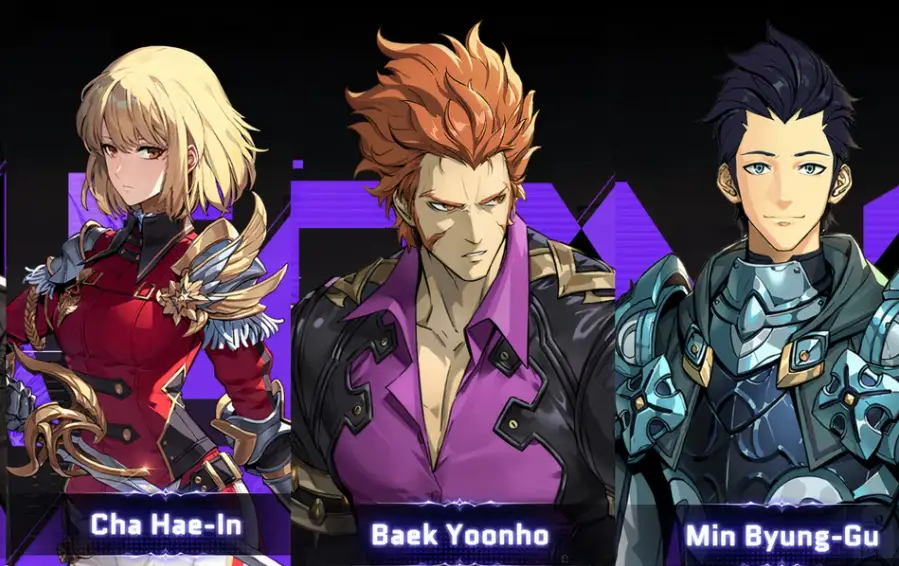
Korea has ten S-rank hunters at the time of the main story. This is considered a high number globally. The table below lists all ten with their guild affiliations and the arcs where they appear.
| Hunter | Guild | Notable Arc |
|---|---|---|
| Choi Jong-in | Hunters Guild (Master) | Jeju Island Raid |
| Baek Yoon-ho | White Tiger Guild (Master) | Red Gate Arc, Jeju Island Raid |
| Lim Tae-gyu | Fiend Guild (Master) | Jeju Island Raid |
| Ma Dong-wook | Fame Guild (Master) | Jeju Island Raid |
| Min Byung-gyu | No guild — independent healer | Jeju Island Raid |
| Cha Hae-in | Hunters Guild (Vice Master) | Multiple arcs — second female S-rank in Korea |
| Lee Eun-seok | No guild — independent | Referenced in guild conference |
| Go Gun-hee | Hunter’s Association Chairman | Monarchs War Arc |
| Sung Jin-woo | Ahjin Guild (Master) | Every arc from Chapter 29 onward |
| Hwang Dong-soo | Scavenger Guild (Korean branch) | International Guild Arc |
Min Byung-gyu is Korea’s only S-rank healer — a distinction that made him one of the most valuable hunters in the country despite having no offensive ability. His death during the Jeju Island Raid was considered a national loss.
Go Gun-hee was classified as S-rank publicly but his actual power as a Rulers’ vessel placed him significantly above that classification. His public rank did not reflect his real capacity.
What Is National Level?
National Level is not an official Hunter Association rank. It is an informal designation created after the Kamish Raid to describe hunters whose power exceeds what the S-rank classification can meaningfully contain.
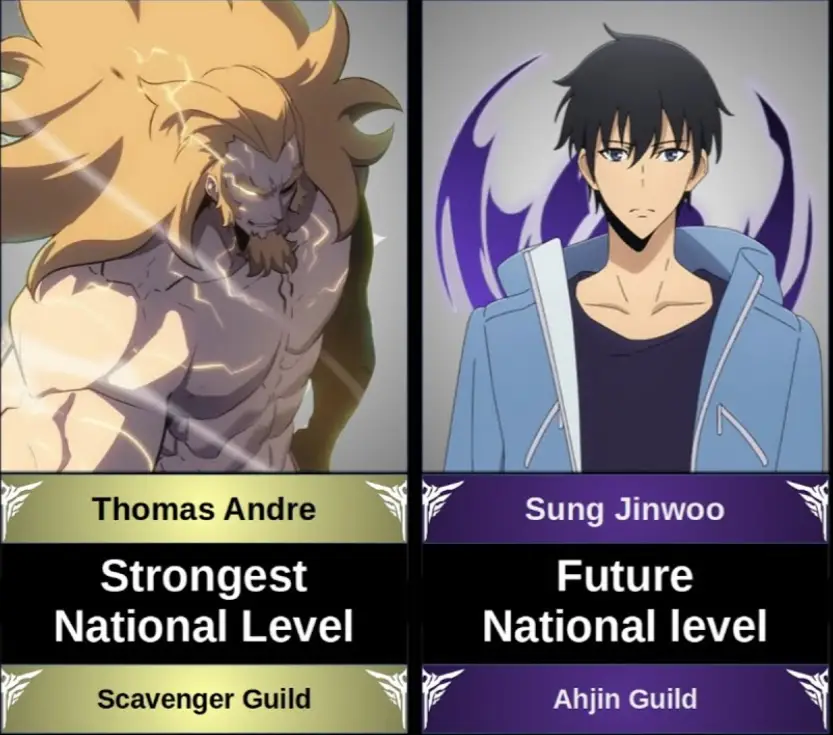
The term originated from a specific event. A dragon named Kamish appeared and tore through multiple S-rank raid parties. Hunters from several countries attempted to stop it and failed. Five hunters eventually killed Kamish — but only after extraordinary losses on all sides. Those five were recognised as being categorically above every other S-rank hunter alive, and the term National Level was coined to reflect that a single one of them could match the military strength of an entire nation.
The original five National Level hunters are listed in the table below.
| Hunter | Country | Guild | Status in Main Story |
|---|---|---|---|
| Thomas Andre | USA | Scavenger Guild (Master) | Active — fights Jin-woo, becomes an ally |
| Liu Zhigang | China | Qilin Guild (Master) | Active — appears at International Guild Conference |
| Christopher Reed | USA | Fame Guild (Master) | Killed by Antares during the Monarchs War |
| Siddharth Bachchan | India | Active — referenced in global rankings | Alive through the main story |
| Unnamed Healer | Unknown | Unknown | Unknown — no further detail given in the manhwa |
The unnamed healer is a significant and deliberate omission by Chugong. The fifth original National Level hunter is confirmed to exist but never named, identified, or shown in the manhwa. Fan communities have speculated extensively about this character but no answer exists in the official material.
Sung Jin-woo became the sixth National Level hunter after his S-rank designation — and quickly made the label irrelevant, because his growth through The System placed him so far beyond National Level that no existing classification applied.
Goto Ryuji, Japan’s strongest hunter, was explicitly stated to be weaker than Korea’s top three S-rank hunters during the Japan Crisis Arc. This established a concrete power scaling reference — the gap between the top Korean S-ranks and the upper range of what other countries produced was significant even before Jin-woo entered the picture.
How Does Jin-woo Fit Into This System?
Jin-woo started at E-rank and ended the series beyond any classification the hunter ranking system was designed to measure.
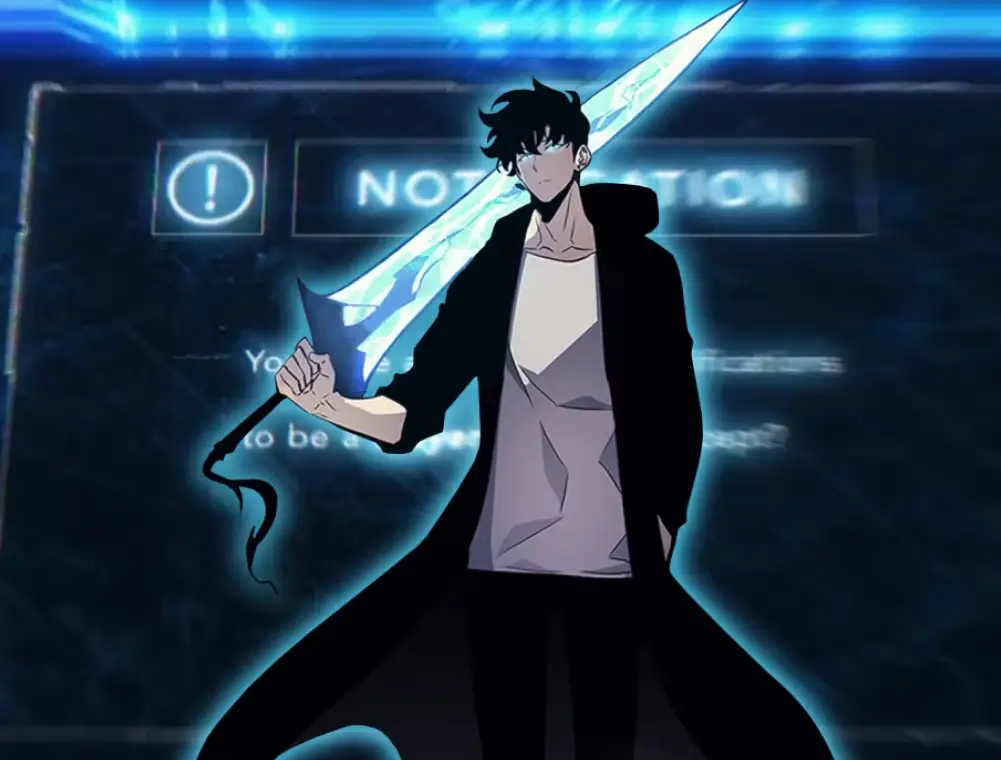
His official reclassification to S-rank happened in Chapter 29 when the measuring equipment broke during his rank retest — the machine had no scale capable of containing what he had become. He was designated S-rank because that was the highest classification available, not because it was accurate.
By the time Jin-woo fights Thomas Andre, he is already beyond National Level. By the Monarchs War, no human classification comes close to describing his output. The ranking system is a framework built for awakened humans. Jin-woo stopped being a conventional awakened human the moment he fully inherited the Shadow Monarch’s power.
Follow Jin-woo’s reclassification to S-rank at Chapter 29 at readsololevelingmanga.us.